11 Hours at the Mall
No third spaces anymore?

They say there are no third spaces anymore, but you can just hang out in the mall from opening to closing. That’s what I did on a recent Monday, spending 11 hours at Westfield Culver City, aka Fox Hills Mall.
I showed up right at 10 a.m., when the mall opened to the flutter of kiosk tarps and the rattle of JC Penney’s roller doors. I would take more than 16,000 steps (and drink two beers) before the day was through.
Why Fox Hills Mall?
Because I have a personal connection to the place. When I moved to Los Angeles in 2009, I only had one friend here, so I often came up with random errands to entertain myself on weekends, such as finding the perfect reversible belt. (The errands were sad, and so was I.) Fox Hills Mall was ideal for those missions, and the shopping center was in the middle of its big Westfield makeover, with one half gentrified and the other not. I loved that the mall was Janus-faced, and I visited often.
Why stay all day?
I revisited the mall recently with my mom — it’s all Westfield now — and I found myself standing on the second floor of the concourse, with a birdseye view of a woman folding dough at Wetzel’s Pretzels. There was a learned fluidity to her movements; her hands, the dough, whatever pop song was playing on the speakers – it was all mesmerizing. I decided to come back and do some thinking about what malls mean now that we’re decades into online shopping, and I wanted to give myself enough time to get bored.
My first lap was quick. Fox Hills is not a large mall. Never has been. If you look at the website, the Trader Joe’s across the parking lot is also part of the property, but that didn’t seem in the spirit of my mission, so I declined to cross that asphalt expanse.
When reviewing the mall’s revamped food court in 2012, Jonathan Gold wrote, “Fox Hills has always been among the most multiracial of Los Angeles malls, downhill from the posh African-American homes of Baldwin Hills and Ladera Heights, close to the Asian and Muslim enclaves of south Culver City, in proximity to Westchester and the Marina, Inglewood and Playa del Rey.”
That diversity was part of the mall’s appeal for me in 2009, and it still makes for great people-watching in 2026. That’s what I did for most of the day, and I was not alone when it came to just hanging out and enjoying the air conditioning. I saw several people again and again in my laps, although we never took it to the level of nodding at one other.
I wandered into Best Buy, and the interior entrance looked more like a warehouse than a place to spend money. It was, as Gen Zers say, a liminal space. The store seemed oriented, partly through neglect, around the idea that everyone would just enter through the parking garage and pick up their online orders and bail. The vibe was unsettling.
I probably visit the mall — and by that I mean any mall — a half-dozen times a year, usually making it quick, but forcing myself to stay all day enabled me to notice how much had changed since I was a teenage mall rat in the 1990s. So many places were now selling collectible toys, presumably because the fans who congregate online still want to feel the figurines in their hands. Even Target was in on the game, as I learned when I asked a guy why he was standing in line outside the store.
“Random drop for Pokemon,” he said. “We don’t know what it’s going to be.”
Further down the concourse, I was intrigued by a sign for New Journalist cologne, with a blue bottle emblazoned with the Esquire logo. I asked for a sample and you can make your own jokes about how it smelled.
I walked and I walked, and I got bored enough to have some really random thoughts, which was the goal. I started to see connections between shoeboxes and storefronts and screens and apps. So much web design is modeled on the physical shape of the mall, and not just in a skeuomorphic sense. Nature gives us few straight lines, but somewhere along the way we figured out that rectangles were best for making things stackable. Then came the grid.
I browsed watches, shoes and jeans. I flipped through shirts, metal hangars whisking on metal rods. Knowing I would be there all day gave me no sense of urgency to buy, and buy nothing I did, except for food and drinks.
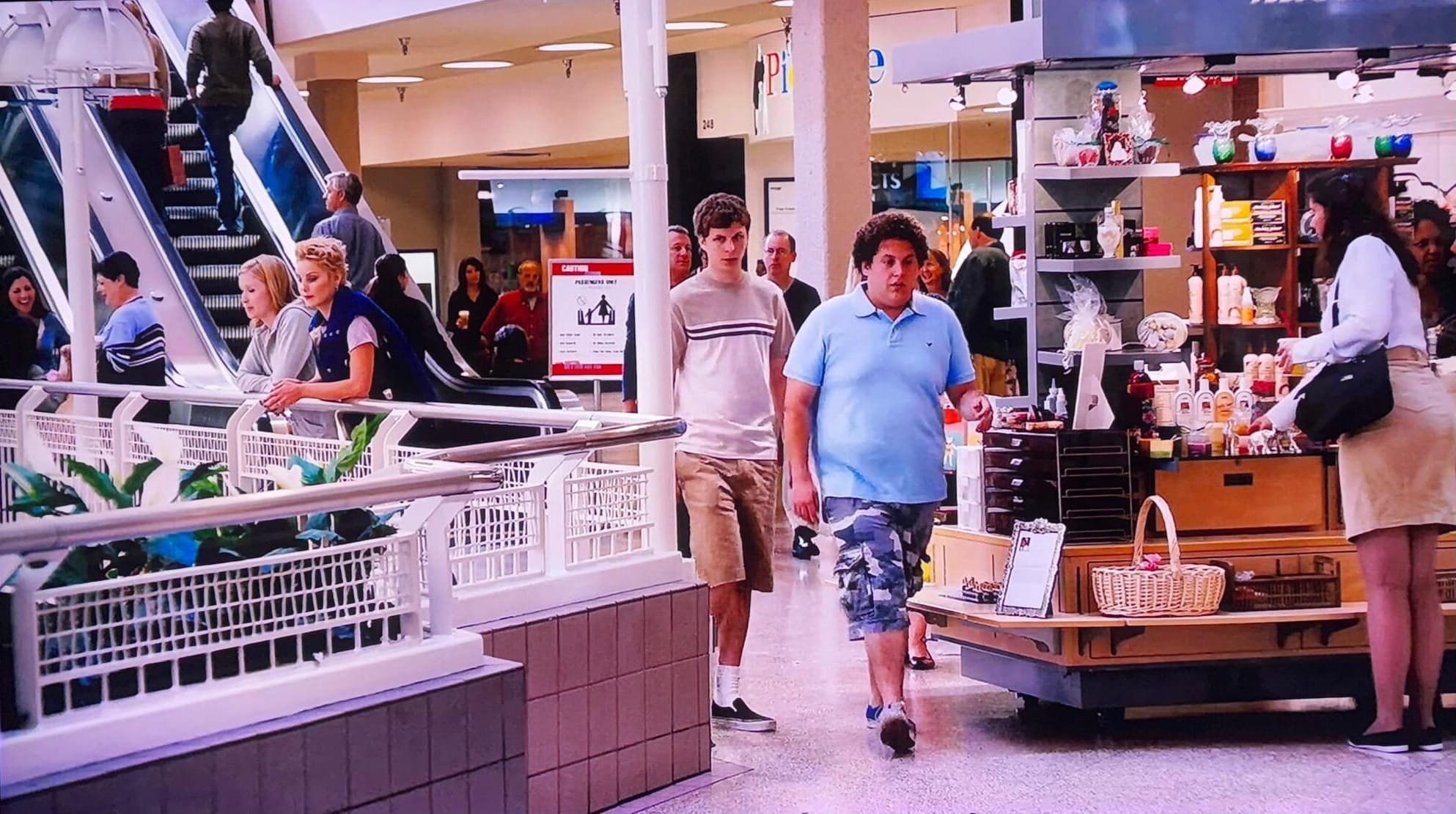
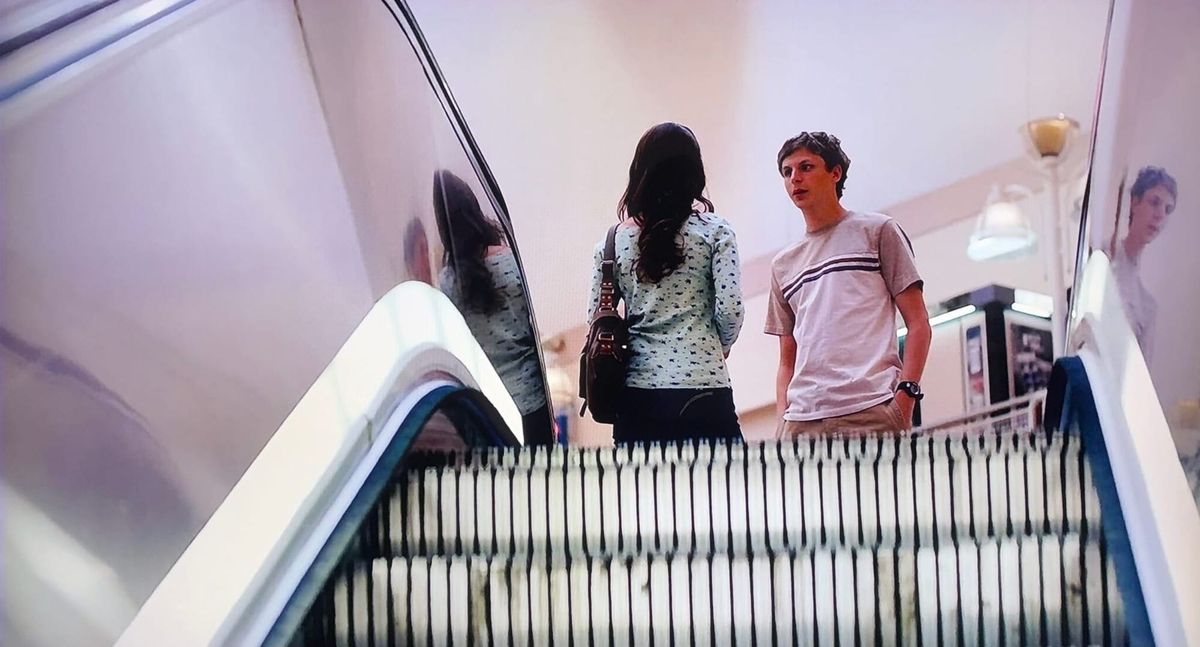
I thought a lot about the final scene of Superbad, which was filmed at Fox Hills. The mall is split into three levels on one side, and the middle floor, between two escalators, is where the final scene goes down. After shopping for pants in a department store, the two protagonists, Evan and Seth, see their love interests coming up the lower escalator. Awkwardness ensues, followed by casual conversation. By the end of the interaction, the boys have separated, each going off with one of the girls. We were told early in the film that they would be going to different universities — that’s the tension — and now we see them part. We can assume they’ll still hang out over the summer, but this scene is their symbolic split.
Superbad was the last great teen comedy of the pre-smartphone era. The movie came out in 2007, the same year as the iPhone. The script was written and produced before smartphones changed so much of how teenagers — along with the rest of us — interacted with each other. Evan and Seth have flip phones, sure, but the devices do not dominate their lives. The boys find out about parties by word of mouth. They pay with cash. When they want to shop, they go to the mall.
Many times throughout the day, I imagined what a cultural theorist would come away thinking if they’d spent a day at the mall in the 1990s, back when I was a teenager, or a decade later, when Superbad was set. This imaginary theorist would’ve written something about how the American mall was a simulacrum of the town square, perhaps with a pun about the mainstreaming of Main Street. The size of the parking lot would’ve been mentioned. And to all of that I say fair enough.
But as I wandered the mall, I found myself overcome with nostalgia. Growing up in the Houston suburbs, the mall was the closet thing I had to a town square. It was my arcadian past. And the people still coming to Fox Hills Mall, to any mall, are keeping that past alive. They are bumping into friends serendipitously. They are looking outside their handheld rectangles, even if that just means entering other rectangles. The rectangles are bigger.
Or at least that’s how I felt after eating ribs and drinking beer at a restaurant called Lucille’s. I left that joint around 8:30 p.m. and walked a few more laps around the concourse, stopping one last time at the Superbad spot.
Back when the movie was filmed, the kiosk between the two escalators sold lotions and soaps. Now it’s a smartphone repair shop.
The mall closed. It was time to go home.