
The Jackass Guide to LA
Nothing shows the streets of Los Angeles as they really are quite like Jackass

The American millennial experience can be defined by a few key moments.
September 11 ended our childhoods. The Great Recession ruined our early job prospects. Late-stage capitalism and pandemic life transformed our transition into middle age.
But before any of that happened, so many millennials (and the youngest Gen Xers) had their lives changed by seven simple words. “Hi, I’m Johnny Knoxville. Welcome to Jackass.”
Now, I could easily write several hundred words on how Jackass was the most important show of the early 2000s and about how it shaped an entire generation. How it gave us dozens of moments that would become cultural touchstones both online and in everyday conversation despite only airing 25 half-hour episodes before switching to movies (of which, Jackass Number Two is obviously the best) and occasional specials.
I could explain how people who weren’t teenage boys when Viva La Bam aired will never understand how wildly influential Bam Margera was and that Wildboyz introduced more young people to wildlife conservation than most major organizations ever do.
But my friend Niko Stratis already penned the best Jackass piece anyone will ever write, and the publication you’re reading right now is supposed to have an LA slant when possible. So instead, here’s the story about how Jackass taught me about Los Angeles before I moved to California.
I come from an East Coast family, and I spent my formative teenage years (watching Jackass) in Arizona, so I’d only been to Los Angeles a few times before moving to the West Coast. And that was for my freshman year of college, but really your freshman year of college shouldn’t be used as a metric for anything other than how many dumb ideas you can survive (again, many thanks to Jackass). And then I moved away again.
So when I moved back to SoCal (Orange County for a year, before realizing I should be in Long Beach) in my mid-20s, it often felt like I was playing catch-up to learn about Los Angeles and its surrounding areas compared to my friends who had been here for years. I accepted early on that I would never really know the area like locals do, but the born-and-raised Angelenos I encountered in my first decade out here were few and far between.
One of the most difficult things to overcome was the version of Los Angeles that gets shown on TV compared to what 99% of us experience on a daily basis. Don’t get me wrong, I still love the wall in Chinatown that says “Rush Hour was shot here” in big letters, but fictional takes on LA (and likely any other city) are pretty far from reality. HBO occasionally nails aspects of life here with scripted shows like Insecure and more recently I Love LA, but nothing shows the streets of Los Angeles as they really are quite like Jackass.
As someone who currently works in Mid-Wilshire and has spent more time than I’d like with musicians in Hollywood and WeHo, I can’t count the number of times I’ve thought “This place looks familiar” only to realize the street, park or concourse was used for a particular Jackass stunt.
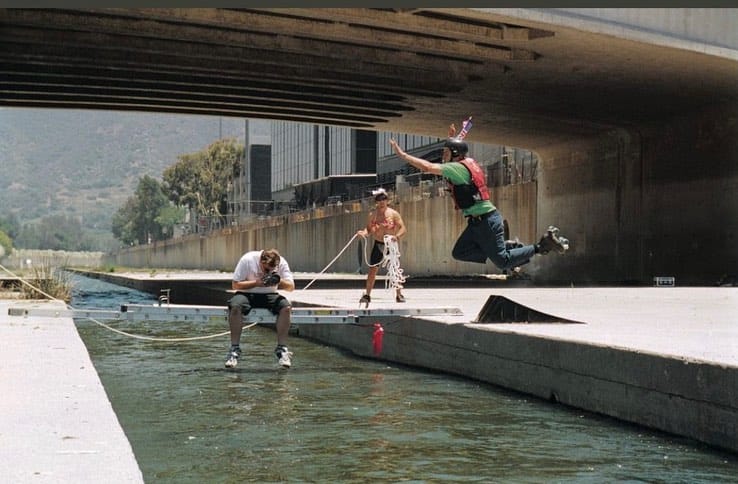
When I look at the Los Angeles River, I’m not reminded of Grease or Terminator 2. Instead, I see Chris Pontius as “Bunny the Lifeguard” ready to rescue Johnny Knoxville after he attempts to jump the river in roller skates and smashes his ankle so hard he needs crutches. While complaining about tourists wanting to wait in line for a hot dog at Pink’s is an Angeleno right of passage, I just remember the time the Jackass crew “kidnapped” Brad Pitt in front of it. And as a proud Long Beach resident, I can’t drive down Cherry just north of the 405 without thinking of Knoxville (as the elderly Irving Zisman) driving his scooter through the glass wall of the motorsports dealership there in Jackass 3D.
But more than recognizable storefronts, Jackass showed the people of Los Angeles living their daily lives (while occasionally being lightly harassed as part of the show’s pranks). The show captured everyone from homeless folks to corporate suits roaming the streets and minding their business until Pontius burst onto the scene as the scantily-clad Party Boy (or later as Satan himself) or Wee Man sprinted around the corner getting chased by Preston Lacy in matching underwear.
Part of its street-level charm came from the fact that Jackass was reality television back when that was still based in reality. Nothing was heavily produced or planned, and everything had a true sense of authenticity about it. The people who were often attempting to “help” the members of the Jackass crew or just spectating their seemingly terrible misfortunes still seem like the ones you’d see riding the Metro or shopping at Ralph’s today.
It’s a notable difference compared to a show like Nathan for You, which also shows plenty of real LA spots and people, but almost everyone involved knows they’re on camera — even if they don’t always know what level of weirdness they’re signing up for with Nathan Fielder. (Although it’s still fun to point out the former “Dumb Starbucks” location in Los Feliz, since people remember that one.)
Of course, Jackass also inspired dumb guys around the world to start filming insane stunts with their friends, even if the show was really built around the personalities and friendships of the folks participating rather than the amount of bodily injuries and fluids on the screen. In no way was its influence singularly focused on LA, but that doesn’t mean I haven’t always wanted to meet someone who was in one of the public pranks.
Yes, Jackass spent plenty of time filming elsewhere. It’s still the only reason I know West Chester is a place in Pennsylvania, and they clearly used their budget increases with each passing season/movie to make various trips around the world. But to me, Jackass will always co-star both the city and residents of Los Angeles in so many of its most memorable sketches.
Jackass: Best and Last begins streaming on September 24 on Paramount+.