
Art of the Bus Stop
What are the ethics of tagging an outdoor artwork with fake graffiti already on it?
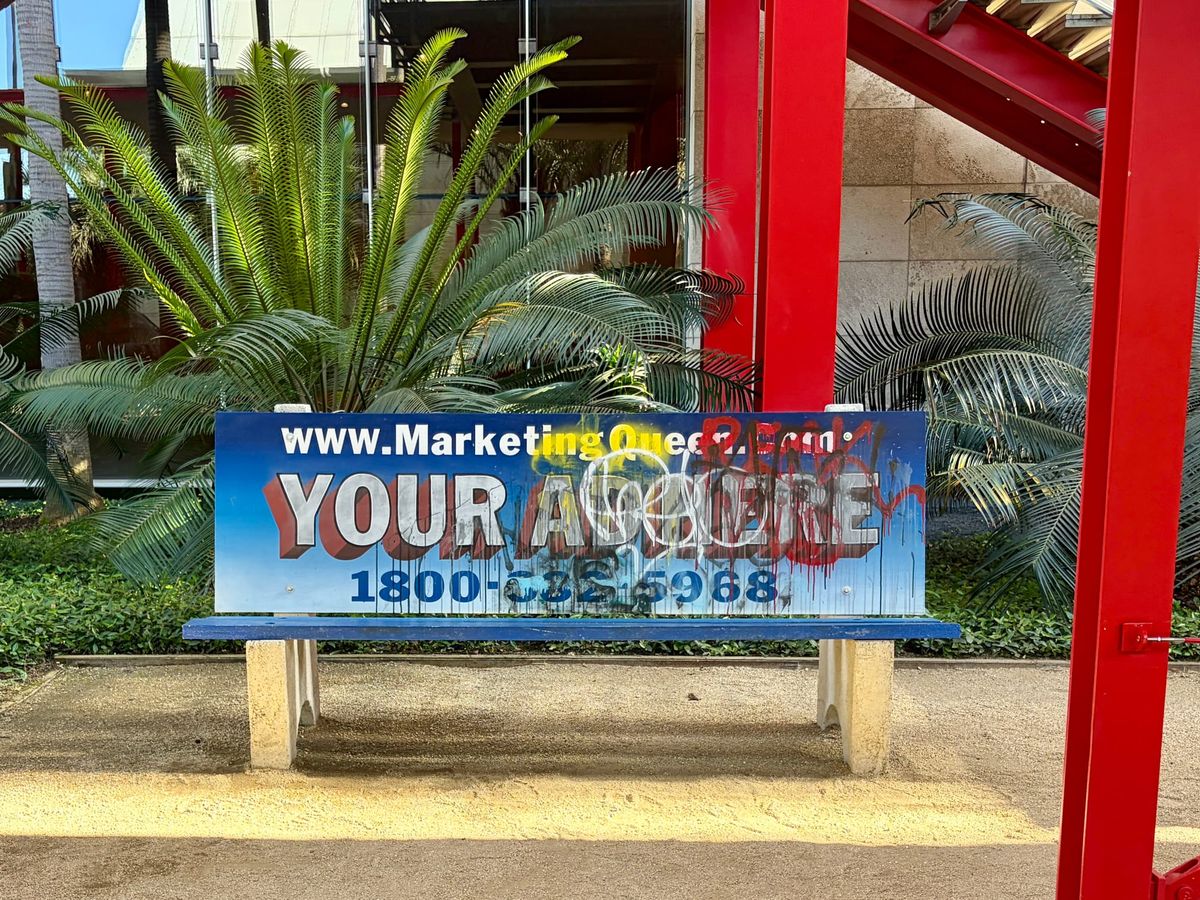
I ask myself this question as I sit on one of Alfonso Gonzalez Jr.’s mock bus benches, staring at another across from me. The other bench has the familiar phrase “YOUR AD HERE” on it, and those words are covered in looping, overlapping scribbles, as if it’s been visited by more than one graffiti writer.
The quick answer is that you should never tag anything, but I have long felt it’s far more OK — or at least far less not OK — to tag an outdoor advertisement placed on public property than, say, a stained glass window in a church. Not all flat surfaces are equally inviolable. There is a spectrum, and I am not sure where on that spectrum I should place this particular bench, which is not an out-of-home advertisement but rather a work on art commenting on all the ads, and maybe all the graffiti too, in the city. Also, Gonzalez used to write graffiti when he was younger, so there’s that.
Gonzalez created the work in question, along with 11 others in the series In Between Stops, for the Los Angeles County Museum of Art, and they line the walkway between the Resnick Pavillion and the Broad Contemporary Art Museum (still my favorite building on the grounds). The benches are getting use, and many people sit on them without, it seems, thinking of their role as art objects. No foul there; sometimes you just want to zone out. On the backrests of those benches are references to works in the LACMA collection, along with recurring characters in Los Angeles advertising.

Anyone who’s ever sat behind a Los Angeles bus knows Veronica, the insurance agent with the besuited German shepherd. (But did you know Veronica is Adriana’s sister!?!) Veronica and her dog make an appearance here on an ad for “ABDUCTION INSURANCE,” which, in this era, calls to mind the masked men of Immigration and Customs Enforcement. That connection is complicated by the inclusion of a little green man in a little green spaceship, which is further complicated by our knowledge of the way the word “alien” get thrown at immigrants. The metaphor is mixed, but in an interesting way, especially when you consider many ICE agents don’t live anywhere near the communities they raid.
Who’s the alien here?
Gonzalez is the son of a sign painter, and he worked in that business for a while too. “Not only would I paint the billboards, I would install the billboards,” he told Julissa James of L.A. Times. “And even before that, when I was really young, I would paint graffiti on billboards.”
Much like James Rosenquist, another sign painter turned gallery artist, Gonzalez has preserved the aesthetic style of his original medium. The figures in his paintings are somewhat cartoonish, so much so that I might not have known I was looking at Veronica, rather than some other insurance agent (maybe even her sister!), were it not for her dog. There is a comfort to Gonzalez’s caricatures, especially as our urban landscape becomes more and more slathered with slop.

We hear a story about abstract expressionism, how it was a reaction to the rise of photography, how artists got weird because technology made realism far too easy. That story is reductive, ignoring the many other reasons for that moment in art history, but there is still a feeling of truth there. Now we’re told that contemporary artists, including those who make show flyers, are keeping their designs a little rough, in reaction to the radioactive sheen of images created by artificial intelligence.
Gonzalez developed his style before the rise of AI, but still, he’s offering an antidote to the consumptive slickness preferred by ersatz politicians and bro lawyers. He’s reflecting the city back to us and, in this series at LACMA, also giving us a place to sit and think.