Laura Aguilar Is Out There
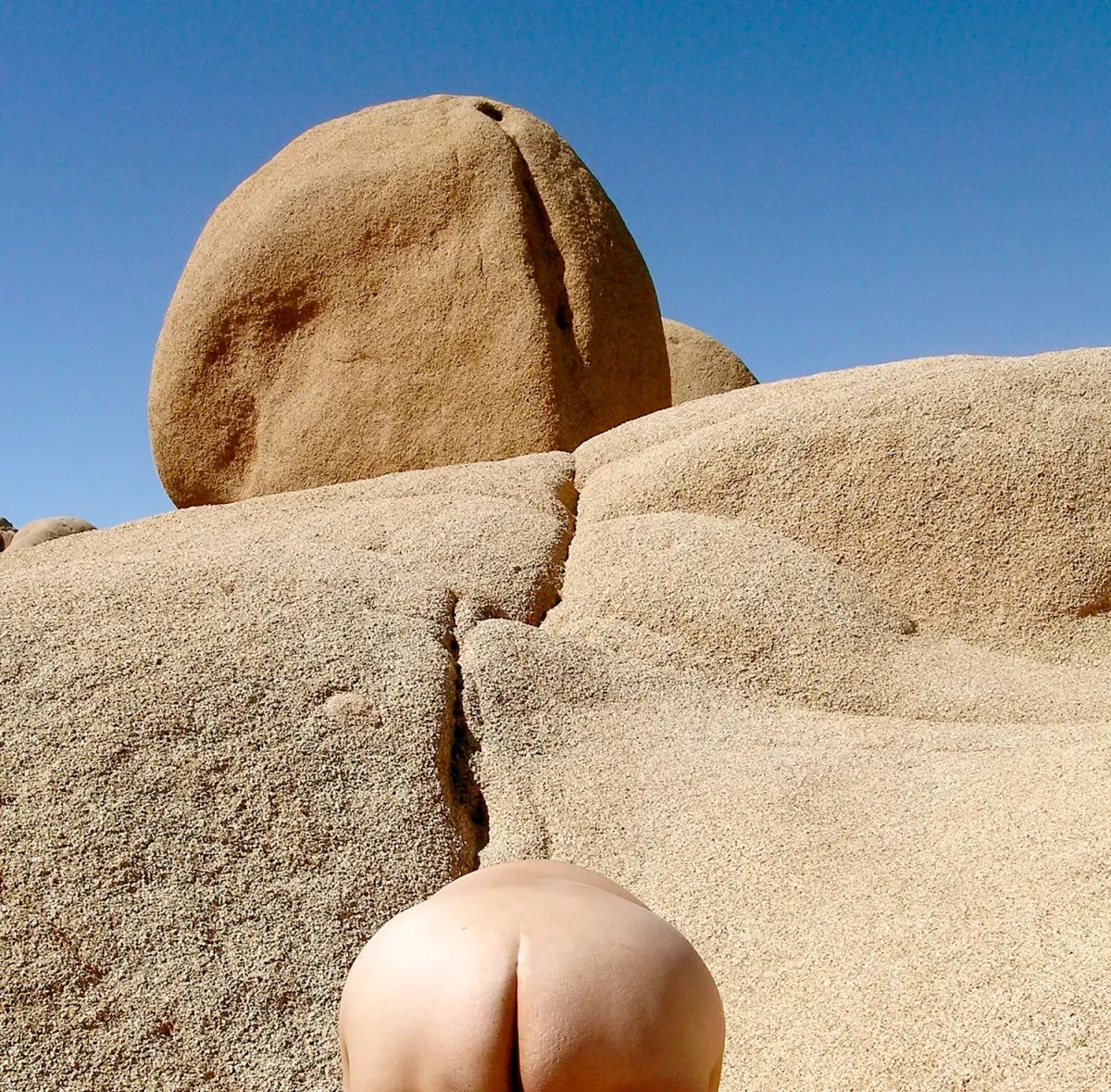
There is a landscape. It is the desert. Not the sandy desert. Rocks. I see cracks and shapes. I see boulders. One of them is not a boulder. It is a human. A nude human. A nude human with a crack. Hiding right out in the open.

Twenty years ago, Laura Aguilar traveled to Joshua Tree National Park and placed herself, au naturale, among the rocks and scrub. The photographs she brought back became Grounded, her final series of self-portraits in nature, and one of her rare forays into color. She had photographed herself nude outdoors before, notably when she traveled to New Mexico 10 years earlier for her Nature Self-Portrait series. In describing those photos, Stefanie Snider wrote that Aguilar’s body “becomes another irregular rocky formation, both blending into her surroundings and, in her liveness and softness of flesh, standing out.” With the Grounded photos, Aguilar took that simultaneous blending in and standing out to another level.
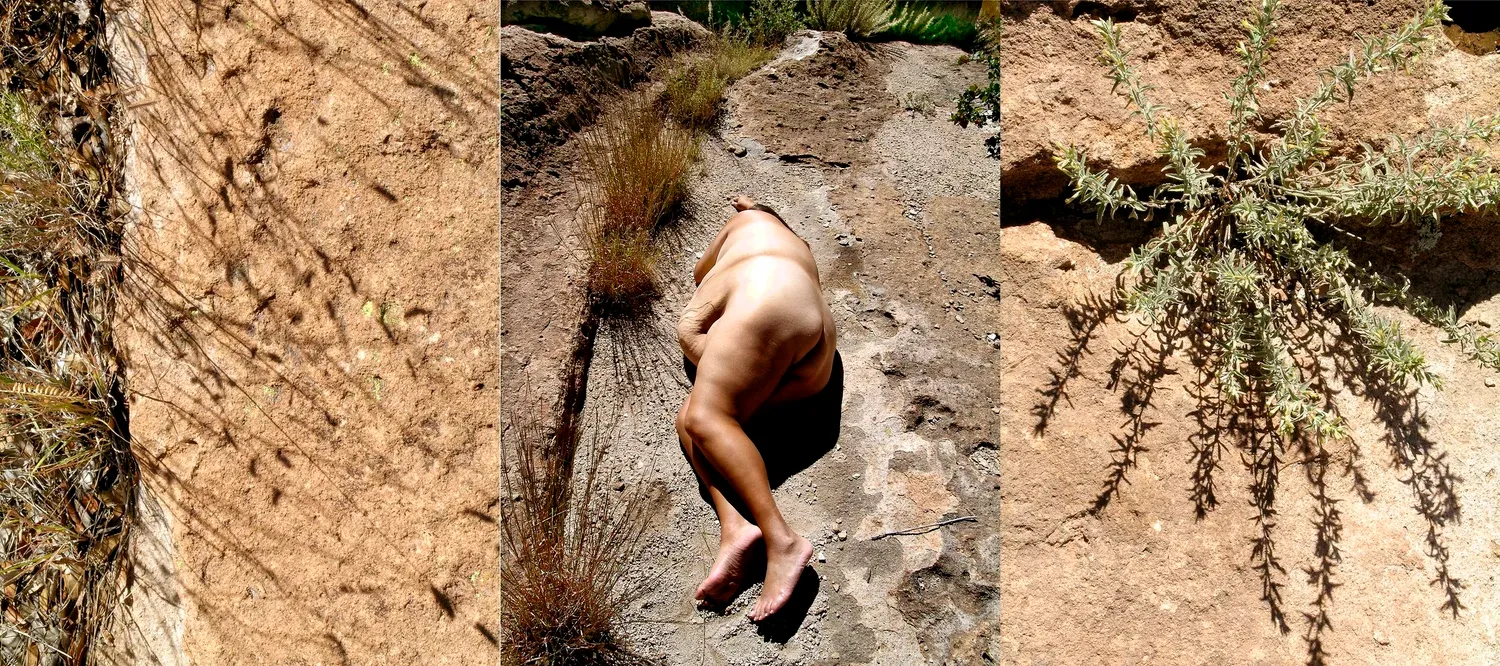
Born in San Gabriel in 1959, Aguilar studied at East Los Angeles College and became part of the East L.A. Chicano art scene, taking photographs of her friends for series such as Latina Lesbians (1986-90) and How Mexican Is Mexican (1990). In 1989, while house-sitting for a friend in Pasadana, she poured herself a Diet Coke, stripped naked and sat down in an armchair in front of an open window. The resulting image, In Sandy’s Room, became one of the most iconic of her career, beginning a body of work focused on her own nude body. In Sandy’s Room was an image easy to place within the long history of nude women reclining, but this time the artist was a woman and the subject was herself and she was a large, queer Latina.

The Huntington has put together many of Aguilar’s nude photos in “Laura Aguilar: Body and Landscape,” a one-room show, which, as the title suggests, places her work within the history of landscape photography. Edward Weston’s Pepper (1929) is also displayed in the room, and the folds of his vegetable call to mind those of Aguilar's torso. The rhyming goes both ways, and after spending some time with Aguilar’s photos, I couldn’t help but see Weston’s pepper as an abstraction of two fat figures embracing.

Aguilar lived with depression and dyslexia, and her photos have been lauded by scholars of Latinx, feminist, queer, fat and disability studies, among others. Her work is generative, opening up various avenues for academics like me. The Vincent Price Art Museum put together a career retrospective of her work in 2017, a year before she died from complications with diabetes. Within the essays that accompanied the retrospective, Macarena Gómez-Barris highlighted how Aguilar’s placement of her body within the desert landscape counteracted the myth that the West was uninhabited before colonization, never mind that there were already people living there. For Snider, the “juxtaposition of flesh and land in these images exposes some of the ways in which fat, queer female bodies of color have been conceived in contemporary culture as the height of visibility and invisibility, all at once.” Other academics have looked at her photos through other lenses, generating even more pages of scholarship, much of it worthwhile.
But what interests me most about the Grounded images is what happens before the discourse part of my brain kicks in, right when I spot Aguilar’s body in the landscape. I am not trying to pretend she is that well hidden. She is not Waldo. But when I first look at many of the Grounded photos, I don’t see her immediately, and there is a magic feeling at the instant of discovery.
Which brings me to Immanuel Kant. Not a name you’d expect to see right after someone has said he’s stepping back from discourse, but I promise I’ll be brief. For Kant, the manifold was the disorganized blur of sensations we experience before our minds start delineating objects and concepts. There is everything, altogether, and then we mark out a table, a musical note, a waft of jasmine. We pull things out of the manifold.

You don’t need Kant for the idea. Newborns can barely see at first, and only as their brains and eyes develop do they make out objects. At any age, we hear foreign languages and cannot discern where each word ends and another begins. Some of us take psychedelics, often in the desert, for a number of reasons, and one of them is to get back to that blur, to experience the world anew.
Aguilar’s final series brings back that blur for me.
I see browns and blues. Desert. Sky. Shapes. Rocks. A human.
I see her. I am barely thinking. She is there.